

When most people hear the word “accountant,” they picture someone sitting behind a desk entering numbers into spreadsheets or preparing tax returns.
While spreadsheets and tax work certainly play a role, the reality is much more interesting.
In fact, one of the biggest surprises many accounting students discover is that the profession is far less about crunching numbers and far more about helping people solve problems.
So what does an accountant actually do?
The answer depends on the day, the client, and the type of accounting professional you’re talking to. But at its core, accounting is about helping individuals, businesses, and organizations make informed financial decisions.
For students considering an accounting major, understanding the day-to-day reality of the profession can help separate fact from fiction.
Accounting Is More Than Tax Season
For many people, their only interaction with an accountant happens during tax season.
As a result, it’s easy to assume that accountants spend all year preparing tax returns.
While tax planning and compliance are important parts of the accounting profession, they represent only one of many possible career paths.
Today’s accountants work in a wide variety of roles, helping businesses manage finances, improve operations, plan for growth, and navigate increasingly complex financial decisions.
The profession extends far beyond filing tax returns.

Helping Businesses Make Better Decisions
Imagine a business owner who wants to hire additional employees, open a second location, purchase equipment, or invest in new technology.
Before making those decisions, they need answers.
Can the business afford it?
How will it impact cash flow?
What are the tax implications?
Will the investment generate a return?
Accountants help answer those questions.
By analyzing financial information and identifying trends, accounting professionals help business owners make informed decisions rather than relying on guesswork.
In many cases, accountants become trusted advisors who help shape the future direction of a business.
No Two Days Are Exactly Alike
One of the biggest misconceptions about the accounting profession is that every day looks the same.
In reality, most accountants work on a variety of projects throughout the week.
A typical day might include:
- Meeting with clients
- Reviewing financial statements
- Researching tax questions
- Analyzing business performance
- Preparing forecasts and budgets
- Collaborating with team members
- Identifying opportunities for improvement
Because every client and organization faces unique challenges, accountants are constantly learning and solving new problems.
That variety is one reason many professionals enjoy the field.
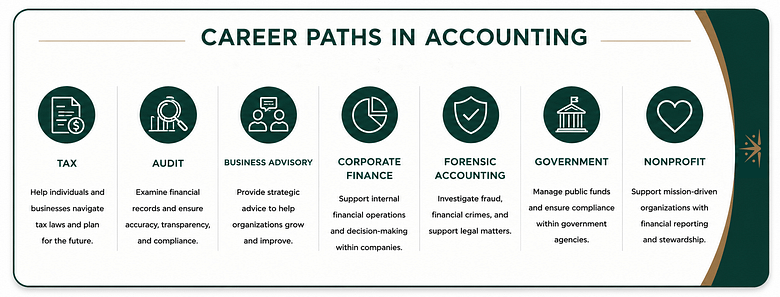
Exploring Different Career Paths
Another benefit of an accounting degree is the variety of opportunities available.
Tax
Tax professionals help individuals and businesses understand tax laws, remain compliant, and identify planning opportunities.
Audit
Auditors evaluate financial records and internal controls to ensure accuracy, transparency, and compliance.
Business Advisory
Advisory professionals help organizations improve profitability, plan strategically, and achieve long-term goals.
Corporate Accounting
Many accountants work directly for companies, helping leadership teams manage finances and support business operations.
Forensic Accounting
Some accountants investigate fraud, financial crimes, and legal disputes.
Government and Nonprofit Accounting
Accounting professionals also play important roles within government agencies, educational institutions, and nonprofit organizations.
The possibilities are much broader than many students initially expect.
Technology Is Changing the Profession
Technology has transformed accounting over the past decade.
Many repetitive tasks that once required hours of manual work can now be automated through modern software and artificial intelligence.
Rather than replacing accountants, technology is allowing them to focus on higher-value activities.
Today’s accounting professionals spend more time:
- Advising clients
- Solving complex problems
- Interpreting data
- Building relationships
- Providing strategic guidance
As technology continues to evolve, the human side of accounting becomes even more important.
Communication Matters More Than You Think
Many students assume accounting is primarily a numbers-focused profession.
In reality, communication is one of the most valuable skills an accountant can develop.
The most successful professionals are often able to:
- Explain complex concepts clearly
- Build trust with clients
- Ask thoughtful questions
- Listen carefully
- Communicate recommendations effectively
Technical knowledge is important, but the ability to help people understand and act on financial information is what often separates good accountants from great ones.
Where Can an Accounting Career Take You?
An accounting degree can open doors to a wide range of opportunities.
Professionals may begin as staff accountants and eventually advance into positions such as:
- Senior Accountant
- Tax Manager
- Controller
- Director of Finance
- Chief Financial Officer (CFO)
- Business Advisor
- CPA Firm Partner
Others choose to become entrepreneurs, consultants, or specialists in niche areas of accounting.
The profession provides a strong foundation for long-term career growth.
The Bottom Line
So what does an accountant actually do?
Much more than most people realize.
Accounting professionals help businesses grow, solve problems, analyze opportunities, manage risk, and make important financial decisions.
For students considering an accounting major, the profession offers a unique combination of business knowledge, problem-solving, technology, communication, and career flexibility.
It’s a career built not only on numbers, but on helping people succeed.
Explore More Career Insights
- Is Accounting Still a Good Career in 2026? What Students Should Know Before Choosing a Major
- Accounting Isn’t Just Taxes: 7 Career Paths You May Not Know Exist
- Can Accountants Make Six Figures? Here’s What the Career Path Looks Like (Coming Soon)
- AI and Accounting: Threat or Opportunity? (Coming Soon)
Interested in Learning More?
At ClearPoint CPAs, we believe accounting is more than numbers—it’s about helping people, businesses, and communities thrive.
Whether you’re considering accounting as a career or simply want to learn more about the profession, we’re always happy to share our experience and insights.